

Dell Xps 13 9380 I5 8265u
Dell XPS 13 9380 2019 (i5-8265U, 256GB, UHD) Subnotebook Review
Ameliorate with Whiskey? The webcam is dorsum at the summit. But is that all for the 2019 XPS 13 from Dell? Not at all, because the dual-fan solution ensures proficient – although not stable – performance utilization we rarely see amid such slim laptops. Update: Review is complete.

At that place is a new version of Dell's popular XPS xiii. The 13.3-inch device with the footprint of a 12-inch laptop from a few years agone is even so one of the thinnest, lightest, and nigh mobile working devices you can currently go. Dell targets mobile power users and enthusiasts with its XPS lineup, and there is no shortage of competitors from Apple, Lenovo, HP, Huawei, or Fujitsu. The air has become thin in the subnotebook market.
Nosotros check the mainstream SKU of the new XPS xiii 9380 with a Whiskey Lake Core i5-8265U, eight GB RAM, 265 GB SSD storage (SK Hynix, NVMe), and a bear upon panel with 3840x2160 pixels. Dell currently offers this spec for 1600 Euros (~$1829).
We will update this live review over the next couple of days. We are looking forward to your feedback and you tin tell us specific aspects you would like us to bank check. What do you desire to know and what should we test in improver to our standard benchmark suite?
Changelog:
- 01/thirty/2019: CPU functioning: Whiskey Lake comes out on elevation, but but under sustained workloads!
- 01/31/2019: Case, build quality, rating, ports, advice, webcam, input devices
- 02/01/2019: Brandish
- 02/04/2019: Ability consumption, speakers, emissions, GPU, verdict
Memory
8192 MB
, LPDDR3-2133 Dual Aqueduct (8GB soldered, not upgradeable)
Display
13.30 inch 16:9, 3840 10 2160 pixel 331 PPI, 10-betoken capacitive, ID: AUO 282B B133ZAN Dell: 90NTH, IPS, glossy: yes
Mainboard
Intel Kaby Lake-U Refresh IMC
Storage
SK hynix PC401 HFS256GD9TNG, 256 GB
, NVMe, 159 GB free
Weight
i.226 kg ( = 43.25 oz / 2.7 pounds), Power Supply: 243 m ( = 8.57 oz / 0.54 pounds)
Note: The manufacturer may employ components from unlike suppliers including display panels, drives or memory sticks with similar specifications.
Case – Webcam is dorsum at the tiptop of the XPS thirteen
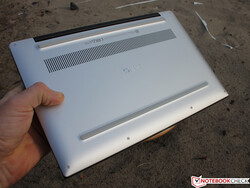
Dell put the webcam back at the pinnacle of the screen, which will be good news for many users. The manufacturer used an extremely small webcam module, which is hardly visible. Right next to the webcam is a tiny white LED that lights up when the webcam is agile.
Dell introduced a new color for the 2018 XPS 13: rose gold. Information technology is still available, while the more common choice is the argent version (our test unit). The chapeau is matte and made of magnesium. The palm rests take a carbon-fiber terminate. It is polish to touch but is still velvety and provides good grip. The advantage of this dark surface is that fingerprints are merely an issue when you take very greasy fingers.
The optional color version differs a bit, because it has an aluminum lid in this color and palm rests made of woven glass fiber in Arctic White. We used a 9370 in this colour and know that information technology does not attract dirt whatever worse than the black model, but the dirt is more visible. This model definitely requires more cleaning.
You will have to clean the white gaps betwixt the keys on the rose-gold SKU from time to time. This is no problem, though, since pressed keys are affluent with the keyboard frame.
Dell does not offering any other colors for the XPS xiii, just silvery and rose-gold (in combination with white surfaces).
The stability of the base of operations unit and the screen is excellent. Pressure from behind is no trouble for the screen and even concentrated pressure at the center does not issue in a distorted motion picture. In that location is simply minor twisting when nosotros attempt really hard, while the base unit itself is extremely sturdy. Nosotros did not hear any creaking sounds when we tried to twist it. We cannot even paring the bottom cover, which is secured by Torx screws. All in all, Dell delivers a very sturdy and well-congenital device.
The competitors are pretty fifty-fifty in terms of weight, the only exception is the Fujitsu LifeBook U930 at simply 930 grams. However, the latter has a more flexible chapeau in return, just the base is very sturdy and well-built. If you want an extremely light device: The LG Gram thirteen (0.939 kg) and the Samsung Notebook nine (0.817 kg) are comparable to the Fujitsu.
It looks similar Dell did not try to make the XPS 13 every bit light as possible but preferred stability and the resulting loftier-quality impression instead. This is also the case for Apple's MacBook Pro 13 2018 at 1.iv kg, even though our XPS 13 is a bit lighter at 1.22 kg. The weight did not modify compared to terminal yr'due south model. You can see why when you open up the chassis, considering the internal layout of the 2 devices, including the motherboard, battery, and cooling, is identical.
The XPS thirteen with the 1080p screen is slightly lighter at one.21 kg due to the lack of a touchscreen.
Size Comparison
❌
Connectivity – XPS Ultrabook with Thunderbolt three
Nosotros are already familiar with the situation from the 9370: The standard USB ports as well as the total-size SD reader have been replaced by 3 USB-C ports and a microSD reader. This is not uncommon for slim laptops, including the MateBook 13 (xv mm) or the Apple tree MacBook Pro 13 2018 (15.five mm).
If you lot prefer a wider selection of ports, you have to get a laptop with a thicker case. Models similar the HP EliteBook 830 G5 as well as the Envy 13 and the ThinkPad X280 offering ports similar USB Type-A, HDMI, and even Ethernet, just at the cost of thicker cases at 18, fifteen, and 17 mm, respectively, compared to 12 mm for the XPS thirteen.
Fujitsu's LifeBook U938 offers a pretty good compromise between slim chassis (15.5 mm) and older ports(HDMI, USB Type-A, RJ45).
The ii Thunderbolt iii ports share a single PCIe-x4 connection (3rd gen 4-lane PCI-Express). All three USB ports can be used for charging, and the two Thunderbolt 3 connectors can double as video outputs (DisplayPort via adapter), so you can attach two external screens.
SD Carte Reader
We use our reference card from Toshiba (Exceria Pro SDXC 64 GB UHS-II) to test the functioning of the microSD reader. The maximum transfer rate is 192 MB/s when we copy large files, while typical jpeg images (about 5 MB each) are transferred at 184 MB/s.
These are excellent results and easily beat out the competition (if they accept a bill of fare reader) and is similar to the predecessor, while laptops like the Huawei MateBook 13 or Apple MacBook Pro 13 2018 do non have a card reader at all.
The microSD menu is not completely flush with the chassis and protrudes by ~1 mm, which is no problem when yous transport the device.
Advice
Dell ships its new XPS 13 with the Wi-Fi module Killer 1435 by default. HWiNFO shows the Atheros/Qualcomm QCA6174 (ac), which supports Bluetooth 4.2 + HS according to the spec sheet. The chip supports MU-MIMO technology with 2x2 antennas. The transfer rates are lower compared to the Apple MacBook Pro 13 2018 or the Lenovo ThinkPad X280. Otherwise, we did not have any issues in combination with our exam router Linksys EA8500.
; iperf3 receive AX12; iperf iii.1.3: Ø523 (459-576)
; iperf3 transmit AX12; iperf three.i.3: Ø594 (579-616)
Webcam
After many complaints from users, Dell put the webcam back on top of the screen. All the same, the quality of the tiny module did not improve, and the resolution is withal stuck at 1280x720 pixels. Images are washed-out and the quality is only sufficient for bones video chats. Colors await pretty real, but the photographic camera has issues with edges and surface structures, they look washed-out and lack any form of structure (see wooden bloom).
Accessories
The box includes a modest USB-C/USB-A adapter as well as a quick-start guide. Dell does not include a protective sleeve or a cleaning cloth.
Maintenance
The bottom comprehend is once again secured by eight Torx T5 screws. It is pretty easy to remove it, but you should be careful non to damage the small plastic hooks. We recommend using a sharp object to remove the bottom encompass.
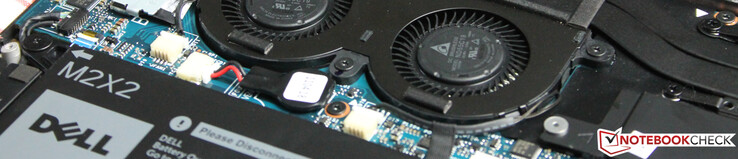
Y'all go access to the ii fans, the CMOS battery, the bombardment equally well as the replaceable Thousand.2-2280 SSD. The Wi-Fi module on the other hand is soldered onto the motherboard.
Warranty
Dell offers comprehensive service options. The base warranty of 12 months tin exist expanded all the mode up to four years. Please run across our Guarantees, Return policies and Warranties article for country-specific data.
Input Devices
Keyboard
Both the illuminated keyboard and the trackpad are identical to the previous model. However, the keys of the rose-gold SKU accept smooth and transparent plastic caps (9370). The size of the trackpad (~10.5 x five cm) as well equally the individual keys (~1.vi x 1.6 mm) and the fundamental travel (one.3 mm) are identical also.
The primal stroke is on the firm side and only the center of the keyboard gives in, but this requires some force. It is no problem to type quickly and the well-defined pressure point ensures good feedback. You might even think the keys are as well soft if you are used to desktop keyboards, maybe fifty-fifty mechanical models. Still, it is pretty firm for a laptop keyboard.
The keys accept a matte surface and tin can exist a bit too slippery. They are not rubberized.
You cannot activate the illumination permanently, but y'all tin can deactivate it permanently. Information technology automatically turns on when y'all utilize the keyboard or the touchpad.
Touchpad
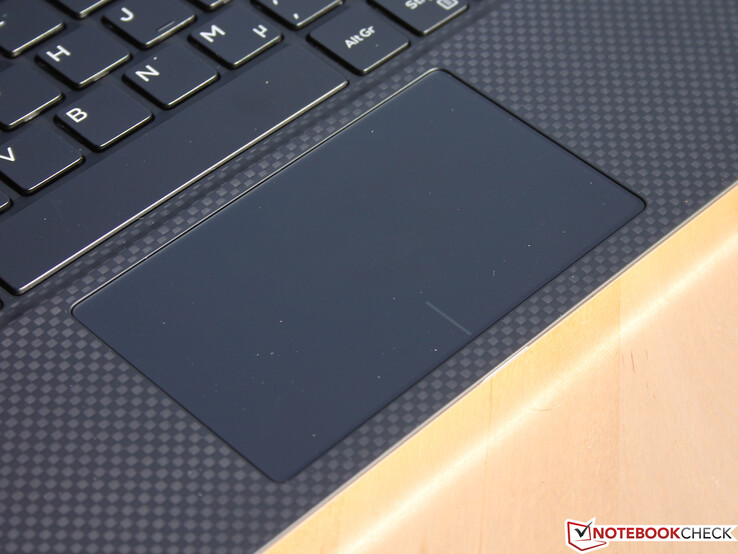
The trackpad has a limited travel from the bottom up to the center, just the feedback is still good cheers to the well-adjusted and aural pressure level point. The surface is smooth and fingers glide easily across.
Touchscreen
The 2019 XPS xiii does not use the IGZO touchscreen (SHP144A) from Precipitous but uses an IPS screen from AUO (B133ZAN). The panel sits behind a layer of drinking glass, which creates a visible gap between the surface and the pixels. We did not experience any bug with bear on inputs (up to x inputs are recognized simultaneously). Fingers hands glide beyond the surface and the screen is very responsive. The glossy surface is obviously prone to fingerprints and has to be cleaned on a regular footing.
Display - Dell Ultrabook now with AUO panel
Something changed: The Dell Ultrabook does not employ a 13.iii-inch panel from Abrupt (4K SKU 2018: SHP148B, LQ1331D1), merely it uses one from AUO (B133ZAN Dell: 90NTH) instead. The specs are identical, and y'all still get a resolution of 3840x2160 pixels.
The 10-finger touchscreen of the XPS 13 4K (capacitive) uses an IPS screen with a glossy surface, is illuminated by LEDs (WLED) and it has a luminance of 340 nits and a contrast ratio of 1800:1 according to panelook.com. Dell advertises different numbers with a 1500:1 contrast ratio and a luminance of 400 nits.
Our measurements testify a lower contrast ratio. The black value is a bit loftier at 0.37, which results in a contrast ratio of "just" 1092:one. This is about identical to the XPS 13 9370 i7 UHD with the Sharp console (113:1). The 1080p screen manages a higher contrast ratio of 1646:1 (9370).
The good news: The AUO panel does not use pulse-width modulation (PWM) for brightness control. This was even so the instance for the 2018 Sharp panel, albeit at a comparatively high frequency.
The luminance is a flake lower; the XPS 13 9370 i7 UHD was xx% brighter on average. We measure 404 nits at the center of the screen of our 9380 with an average event of 389 nits. Backlight haemorrhage is slightly visible at the lower right corner, just it is merely visible at the maximum luminance on a night image. We increased the exposure time significantly for the movie below.
| 390 cd/m² | 412 cd/g² | 430 cd/1000² | ||
| 368 cd/m² | 404 cd/grand² | 388 cd/m² | ||
| 364 cd/thou² | 381 cd/m² | 366 cd/m² | ||
Distribution of brightness
ID: AUO 282B B133ZAN Dell: 90NTH
X-Rite i1Pro ii
Maximum: 430 cd/thou² (Nits) Average: 389.two cd/grand² Minimum: 17 cd/m²
Brightness Distribution: 85 %
Center on Bombardment: 404 cd/m²
Dissimilarity: 1092:one (Black: 0.37 cd/m²)
ΔE Colour iii.72 | 0.59-29.43 Ø5.3, calibrated: 2.06
ΔE Greyscale 4.44 | 0.64-98 Ø5.5
93% sRGB (Argyll 1.6.3 3D)
60% AdobeRGB 1998 (Argyll one.half-dozen.3 3D)
65.3% AdobeRGB 1998 (Argyll two.two.0 3D)
93.i% sRGB (Argyll 2.2.0 3D)
64.seven% Display P3 (Argyll 2.2.0 3D)
Gamma: two.34
| Dell XPS thirteen 9380 2019 ID: AUO 282B B133ZAN Dell: 90NTH, , 3840x2160, 13.30 | Dell XPS xiii 9370 i7 UHD ID: Abrupt SHP148B, Name: LQ133D1, Dell P/N: 8XDHY, , 3840x2160, xiii.30 | Dell XPS 13 9370 FHD i5 SHP1484, , 1920x1080, xiii.thirty | Apple MacBook Pro 13 2018 Touchbar i5 APPA03E, , 2560x1600, 13.30 | Lenovo ThinkPad X280-20KES01S00 B125HAN02.2, , 1920x1080, 12.50 | Fujitsu Lifebook U938 Abrupt LQ133M1JW28, , 1920x1080, 13.30 | HP EliteBook 830 G5-3JX74EA IVO M133NVF3-R0, , 1920x1080, 13.30 | HP Envy 13-ah0003ng M133NVF3 R0, , 1920x1080, 13.30 | Huawei MateBook 13 i7 Chi Mei CMN8201, , 2160x1440, 13.00 | |
|---|---|---|---|---|---|---|---|---|---|
| Brandish | 6% | 6% | 31% | -31% | four% | -2% | -13% | 5% | |
| Display P3 Coverage | 64.7 | 68.nine 6% | 68.9 six% | 98.5 52% | 44 -32% | 67.5 4% | 64.ii -one% | 54.viii -15% | 68.ane five% |
| sRGB Coverage | 93.1 | 98.4 half dozen% | 96.six four% | 99.nine 7% | 64.five -31% | 94.5 2% | 89.two -iv% | 82.5 -11% | 97.seven v% |
| AdobeRGB 1998 Coverage | 65.three | 69.5 6% | 69.6 7% | 87.3 34% | 45.45 -30% | 68.7 5% | 65.2 0% | 56.6 -xiii% | 69.2 half dozen% |
| Response Times | -21% | -eighteen% | xvi% | 25% | 23% | 35% | forty% | nineteen% | |
| Response Fourth dimension Greyness 50% / Grayness fourscore% * | 58 ? | 69.vi ? -20% | 62.iv ? -viii% | 46 ? 21% | 40 ? 31% | 43 ? 26% | 36 ? 38% | 31 ? 47% | 43.2 ? 26% |
| Response Time Black / White * | 36 ? | 44 ? -22% | 45.6 ? -27% | 32 ? 11% | 29.six ? 18% | 29 ? xix% | 24.8 ? 31% | 24 ? 33% | 32 ? 11% |
| PWM Frequency | 3759 ? | 1008 ? | 118000 ? | 217 ? | 1020 ? | 1000 ? | |||
| Screen | 12% | x% | 34% | -18% | 6% | -8% | 19% | 5% | |
| Brightness middle | 404 | 478.5 18% | 428 6% | 519 28% | 344 -15% | 344 -fifteen% | 316 -22% | 289 -28% | 366.vi -9% |
| Brightness | 389 | 466 20% | 405 4% | 504 30% | 313 -20% | 320 -18% | 326 -16% | 310 -xx% | 360 -vii% |
| Brightness Distribution | 85 | 86 i% | 87 2% | 95 12% | 82 -4% | 77 -9% | 85 0% | 85 0% | 93 9% |
| Black Level * | 0.37 | 0.43 -16% | 0.26 30% | 0.33 11% | 0.25 32% | 0.31 16% | 0.19 49% | 0.23 38% | 0.39 -5% |
| Contrast | 1092 | 1113 ii% | 1646 51% | 1573 44% | 1376 26% | 1110 2% | 1663 52% | 1257 fifteen% | 940 -14% |
| Colorchecker dE 2000 * | 3.72 | three.09 17% | three.viii -2% | 1.4 62% | iv.7 -26% | 2.72 27% | 4.v -21% | 1.64 56% | 2.76 26% |
| Colorchecker dE 2000 max. * | 7.38 | 5.94 20% | vii.ii 2% | 2.8 62% | nineteen.4 -163% | five.92 20% | 12.1 -64% | 3.31 55% | half-dozen.19 16% |
| Colorchecker dE 2000 calibrated * | ii.06 | 2.06 -0% | 2.9 -41% | 0.99 52% | i.53 26% | ||||
| Greyscale dE 2000 * | 4.44 | 2.iv 46% | four.4 1% | 2.2 50% | 2.2 50% | 2.74 38% | five -13% | 1.71 61% | 4.2 v% |
| Gamma | 2.34 94% | 2.063 107% | ii.21 100% | two.22 99% | 2.16 102% | 2.38 92% | 2.22 99% | ii.32 95% | 2.22 99% |
| CCT | 7095 92% | 6883 94% | 7067 92% | 6908 94% | 6252 104% | 6794 96% | 6018 108% | 6291 103% | 6271 104% |
| Color Space (Percent of AdobeRGB 1998) | lx | 69.47 16% | 62.8 5% | 77.iii 29% | 41.2 -31% | 61 2% | 57.9 -3% | 52 -thirteen% | 63.2 v% |
| Color Infinite (Percent of sRGB) | 93 | 98.36 half-dozen% | 96.4 iv% | 99.99 8% | 64.1 -31% | 94 1% | 87.iii -half dozen% | 82 -12% | 97.6 5% |
| Total Average (Plan / Settings) | -1% / 7% | -ane% / half dozen% | 27% / 31% | -8% / -15% | 11% / 8% | 8% / -i% | 15% / 15% | ten% / 7% |
* ... smaller is improve
The color gamut is pretty much identical at sixty% AdobeRGB and 93% sRGB; the Sharp SKU from 2018 still managed 98% sRGB.
The color accuracy ex-works is a bit worse, more precisely the grayscale performance. The DeltaE deviation increased to iv.4, while the Sharp panel managed 2.4 out of the box. Notwithstanding, this problem tin be solved by calibration (photospectrometer), and the DeltaE value (grayscale) was reduced to 1.0.
Scale also helps to ameliorate the high color departure of 3.7. We determine 2.0 later on calibration, which ways the color accuracy is almost perfect (target color space sRGB).
Every bit always, we linked the color contour (ICC file X-Rite i1Pro 2) of our XPS xiii 9380 with the 4K panel in the box above. Delight brand sure that your device uses the same console (AUO B133ZAN). Otherwise, the color accuracy volition probably be worse.
You tin can employ the Dell XPS xiii with the impact panel in the sun, but there are limitations. The maximum luminance of ~400 nits (which is reduced to 363 nits on bombardment) is certainly sufficient, but the glossy screen surface rapidly becomes an issue. You will accept to search for a place in the shade to run into the brandish content comfortably. The 1080p screen too has a sleeky screen, but at least our 2018 SKU was a bit brighter, so information technology might be favorable outdoors.
The luminance is reduced to 363 nits on bombardment power. It is the default setting in the BIOS (F2: Video/LCD Brightness) and can exist deactivated, so the brightness is identical on mains and battery.
Dynamic Backlight Control is once once again included and was formerly known every bit Content Adaptive Effulgence Command (CABC). This characteristic, which helps to save power past dynamically adapting the brightness based on the screen content, was a large annoyance in the by. Users reported flickering screens and Dell had to deploy a tool to conciliate CABC.
Now, you can just deactivate DBC (CABC) in the BIOS, both on bombardment besides as mains. The BIOS shows the annotation "if the panel supports it". So far, nosotros did non discover out whether our UHD screen supports CABC in the start place.
Nosotros deactivated DBC for our battery runtime exam to ensure a stock-still luminance of 150 nits (Wi-Fi test), which corresponds with 35% of the maximum luminance on our test unit.
Display Response Times
ℹ
Display response times show how fast the screen is able to change from one color to the next. Slow response times tin can pb to afterimages and can crusade moving objects to appear blurry (ghosting). Gamers of fast-paced 3D titles should pay special attention to fast response times.
| ↔ Response Time Black to White | ||
|---|---|---|
| 36 ms ... rise ↗ and fall ↘ combined | ↗ 20 ms rise |  |
| ↘ 16 ms fall | ||
| The screen shows dull response rates in our tests and volition be unsatisfactory for gamers. In comparison, all tested devices range from 0.iv (minimum) to 240 (maximum) ms. » 92 % of all devices are better. This ways that the measured response time is worse than the average of all tested devices (23 ms). | ||
| ↔ Response Time 50% Grey to 80% Grey | ||
| 58 ms ... rising ↗ and fall ↘ combined | ↗ 26 ms rise |  |
| ↘ 32 ms autumn | ||
| The screen shows slow response rates in our tests and will be unsatisfactory for gamers. In comparison, all tested devices range from 0.25 (minimum) to 636 (maximum) ms. » 93 % of all devices are better. This means that the measured response time is worse than the average of all tested devices (36.three ms). | ||
Screen Flickering / PWM (Pulse-Width Modulation)
ℹ
To dim the screen, some notebooks will simply cycle the backlight on and off in rapid succession - a method chosen Pulse Width Modulation (PWM) . This cycling frequency should ideally be undetectable to the human eye. If said frequency is too low, users with sensitive eyes may experience strain or headaches or even find the flickering altogether.
| Screen flickering / PWM non detected |  | ||
| In comparison: 52 % of all tested devices do not apply PWM to dim the display. If PWM was detected, an boilerplate of 19802 (minimum: 5 - maximum: 3846000) Hz was measured. | |||
The viewing angles are on the expected level for an IPS screen. The brightness drops a bit from wider angles, but there are no noteworthy colour shifts, even from extreme viewing positions.

Performance – Whiskey Lake in the 2019 XPS
Dell ships its XPS with a powerful processor. The quad-core Intel Core i5-8265U based on the Whiskey Lake compages is supported by 8 GB RAM and a 256 GB SSD from SK Hynix. Our test unit is equipped with the UHD touchscreen, which has a native resolution of 3840x2160 pixels.
It is the mainstream SKU of the Dell XPS 13 that costs well-nigh 1600 Euros (~$1829). Dell also offers the XPS 13 with a Core i3 for the offset time, with the Intel Core i3-8145U. The entry-level spec with 128 GB SSD storage, 1080p screen (non-impact) and only 4 GB RAM currently starts at 1100 Euros (~$1257). The near-expensive SKU is available for 1950 Euros (~$2229) and comes with a Core i7-8565U, sixteen GB RAM and 512 GB SSD storage. This model uses the same 4K UHD (3840x2160) InfinityEdge touchscreen from our examination unit.
Our SKU with the loftier-resolution display and the Core i5 should be a popular choice for many customers, and the system functioning is more than sufficient for near common (and even professional) tasks.
Processor
The Intel Core i5-8265U quad-core processor is a ULV flake (TDP 15W) based on Intel's Whiskey Lake architecture. The processor runs at a base frequency of 1.6 GHz, but it can accomplish up to 3.seven GHz (all 4 cores), 3.eight GHz (two cores), or 3.9 GHz (one cadre) via Turbo Boost.
The Whiskey Lake architecture of the Core i5-8265U processor does not differ much from the previous Kaby Lake architecture used for the 2018 XPS thirteen. The per-MHz performance is identical, but the improved manufacturing process of Whiskey Lake allows higher clock rates. In theory, the higher frequency of the 8265U should be faster than the previous Core i5-8250U processor in our CPU benchmarks. Nevertheless, this is not the instance: The Cinebench R15 Multi examination shows both CPUs are similarly fast, and the new chip is only 3% ahead in the Single test. This is the case for one benchmark run, but the Whiskey Lake chip is ahead under sustained workloads.
Every bit always, the interesting question is whether the cooling solution can maintain the operation when the load menses is longer. Slim subnotebooks often struggle with this job, and the initial loftier operation (Turbo Boost) often drops by fifteen-thirty%, which results in lower benchmark scores compared to the initial run. So what nigh the 2019 XPS 13?
The processor starts with 3.7 GHz in the Cinebench R15 Multithread, but it drops to 3.3-3.4 GHz later on a couple of seconds. This level can be maintained for the first four minutes, because the chip warms upwardly to 99 °C and occasionally has to reduce the clocks down to 2.v GHz. The CPU cools downwardly to 80 °C in these periods, earlier information technology increases the clock and warms upwardly to almost 100 °C over again.
The starting time picture shows the development of the temperature and the processor frequency with the Optimized performance mode. The second picture shows the same data with the performance mode Ultra. The average clock is pretty much identical, but the beliefs changes: The periods with higher clocks than 2.5 GHz are longer, but the clock climbs slower in return.
The results of the Cinebench R15 loop show an reward for the Ultra fashion, but the difference is small-scale: 574 up to 666 points (Optimized, 597 on average) vs. 518 upward to 672 points (Ultra mode, 614 on average). The Ultra fashion as well has bigger fluctuations.
All in all, Dell is able to utilize the performance of the Whiskey Lake i5 very well, but the loftier clocks often result in core temperatures close to 100 °C. The previous model 8250U behaved differently and the performance in the CB loop was lower. We have already seen more bourgeois CPU settings, which lost betwixt 15-30% percent later on the first iterations. Our XPS thirteen only loses 8% of its original operation (~xiv% for the previous 9370).
A quick look at the competitors in the subnotebook segment likewise shows that the XPS 13 i5 performs very well and is but beaten by the Apple tree MacBook Pro 13 (i5-8259U).
Our results were adamant on mains, simply the CPU frequency is much lower on battery power. 1.8-2.half-dozen GHz in the Multi test and 1.four-1.8 GHz in the Single test merely results in 535 or 114 points, respectively, which is a deficit of xx (Multi) and 23% (Single).
Cinebench R15 CPU Multi 64Bit
666 Points
Cinebench R15 OpenGL 64Bit
51.nine fps
Cinebench R15 Ref. Lucifer 64Bit
97.8 %
Cinebench R15 CPU Unmarried 64Bit
148 Points
Aid
System Performance
The combination of solid country bulldoze, quad-core processor, and dual-channel memory ensures a responsive user experience. The integrated GPU is powerful enough for older or less-enervating games.
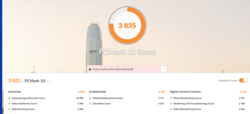
Nosotros determine very proficient results in the synthetic PCMark benchmarks, but we did non expect anything else. Our XPS 13 is only beaten by the Huawei MateBook thirteen (Whiskey Lake i7), which has an reward thanks to its defended MX150 GPU (PCMark 10 score +13%).
Interesting: The 2019 XPS 13 is just slightly (if at all) faster than the XPS 13 9370 FHD i5. Potential buyers should keep that in mind before they spend their coin, it's possible that a 2018 XPS thirteen could be the better choice. We volition pick this topic up in the terminal verdict and requite our recommendation.
| PCMark 10 | |
| Score | |
| Average of class Subnotebook (1671 - 6414, n=101, last 2 years) | |
| Huawei MateBook 13 i7 | |
| Lenovo ThinkPad X280-20KES01S00 | |
| Dell XPS 13 9380 2019 | |
| HP EliteBook 830 G5-3JX74EA | |
| HP Green-eyed 13-ah0003ng | |
| Dell XPS xiii 9370 FHD i5 | |
| Dell XPS 13 9370 i7 UHD | |
| Average Intel Core i5-8265U, Intel UHD Graphics 620 (2247 - 3985, n=29) | |
| Fujitsu Lifebook U938 | |
| Apple MacBook Pro thirteen 2018 Touchbar i5 | |
| Essentials | |
| Boilerplate of class Subnotebook (4599 - 10836, n=101, terminal 2 years) | |
| Huawei MateBook thirteen i7 | |
| Dell XPS 13 9380 2019 | |
| HP EliteBook 830 G5-3JX74EA | |
| Dell XPS xiii 9370 FHD i5 | |
| Lenovo ThinkPad X280-20KES01S00 | |
| Average Intel Cadre i5-8265U, Intel UHD Graphics 620 (5073 - 8689, north=29) | |
| HP Envy 13-ah0003ng | |
| Dell XPS 13 9370 i7 UHD | |
| Apple MacBook Pro thirteen 2018 Touchbar i5 | |
| Fujitsu Lifebook U938 | |
| Productivity | |
| Huawei MateBook 13 i7 | |
| Average of course Subnotebook (2813 - 9852, n=101, last 2 years) | |
| Lenovo ThinkPad X280-20KES01S00 | |
| HP EliteBook 830 G5-3JX74EA | |
| HP Envy 13-ah0003ng | |
| Dell XPS 13 9380 2019 | |
| Fujitsu Lifebook U938 | |
| Average Intel Cadre i5-8265U, Intel UHD Graphics 620 (2941 - 6556, n=29) | |
| Dell XPS 13 9370 FHD i5 | |
| Dell XPS 13 9370 i7 UHD | |
| Apple MacBook Pro thirteen 2018 Touchbar i5 | |
| Digital Content Cosmos | |
| Average of class Subnotebook (973 - 7298, n=101, concluding two years) | |
| Huawei MateBook thirteen i7 | |
| Dell XPS 13 9380 2019 | |
| HP Envy 13-ah0003ng | |
| Dell XPS 13 9370 FHD i5 | |
| Lenovo ThinkPad X280-20KES01S00 | |
| Dell XPS 13 9370 i7 UHD | |
| Apple MacBook Pro 13 2018 Touchbar i5 | |
| HP EliteBook 830 G5-3JX74EA | |
| Average Intel Core i5-8265U, Intel UHD Graphics 620 (2067 - 3210, n=29) | |
| Fujitsu Lifebook U938 | |
| PCMark 8 | |
| Home Score Accelerated v2 | |
| HP Envy thirteen-ah0003ng | |
| Dell XPS 13 9370 FHD i5 | |
| HP EliteBook 830 G5-3JX74EA | |
| Boilerplate of class Subnotebook (1083 - 5361, north=27, last 2 years) | |
| Fujitsu Lifebook U938 | |
| Apple tree MacBook Pro 13 2018 Touchbar i5 | |
| Huawei MateBook 13 i7 | |
| Lenovo ThinkPad X280-20KES01S00 | |
| Dell XPS 13 9380 2019 | |
| Average Intel Core i5-8265U, Intel UHD Graphics 620 (2747 - 4244, northward=24) | |
| Dell XPS 13 9370 i7 UHD | |
| Piece of work Score Accelerated v2 | |
| HP EliteBook 830 G5-3JX74EA | |
| HP Envy 13-ah0003ng | |
| Dell XPS 13 9370 FHD i5 | |
| Lenovo ThinkPad X280-20KES01S00 | |
| Fujitsu Lifebook U938 | |
| Huawei MateBook 13 i7 | |
| Average Intel Core i5-8265U, Intel UHD Graphics 620 (3132 - 4927, northward=23) | |
| Apple tree MacBook Pro 13 2018 Touchbar i5 | |
| Dell XPS 13 9380 2019 | |
| Average of grade Subnotebook (2460 - 5628, n=25, last ii years) | |
| Dell XPS xiii 9370 i7 UHD | |
| PCMark 8 Home Score Accelerated v2 | 3519 points | |
| PCMark 8 Piece of work Score Accelerated v2 | 4302 points | |
| PCMark 10 Score | 3835 points | |
| Assist | ||
Storage Devices
The 256 GB SSD from SK Hynix carries the designation PC401 HFS256GD9TNG, which is an NVMe-PCIe One thousand.2 bulldoze. You tin use 159 GB for your own files later on the initial setup.
The SSD manages pretty high transfer rates but cannot quite compete with the Samsung SSD PM981 and PM961 (ThinkPad X280 / HP EliteBook 830 G5-3JX74EA; +56%). Even the Toshiba XG5 (XPS thirteen 9370) from 2018 was faster overall (+47%), which is caused past the insufficiently low sequential read/write results.
| Dell XPS 13 9380 2019 SK hynix PC401 HFS256GD9TNG | Dell XPS 13 9370 FHD i5 Toshiba XG5 KXG50ZNV256G | Apple MacBook Pro 13 2018 Touchbar i5 | Lenovo ThinkPad X280-20KES01S00 Samsung SSD PM981 MZVLB512HAJQ | Fujitsu Lifebook U938 Micron 1100 MTFDDAV256TBN | HP EliteBook 830 G5-3JX74EA Samsung SSD PM961 1TB M.ii PCIe iii.0 x4 NVMe (MZVLW1T0) | HP Envy thirteen-ah0003ng SK Hynix BC501 HFM512GDJTNG | Huawei MateBook 13 i7 Samsung SSD PM981 MZVLB512HAJQ | Boilerplate SK hynix PC401 HFS256GD9TNG | |
|---|---|---|---|---|---|---|---|---|---|
| CrystalDiskMark v.2 / vi | 47% | 3% | 58% | -32% | 56% | 6% | 100% | 12% | |
| Write 4K | 84.half-dozen | 128.2 52% | 43.24 -49% | 125.3 48% | 80.5 -5% | 108.5 28% | 112.9 33% | 159.4 88% | 101.8 ? 20% |
| Read 4K | 38.52 | 48.09 25% | 14.07 -63% | 43.5 thirteen% | 26.14 -32% | 40.53 v% | 38.69 0% | 47.31 23% | 40.nine ? vi% |
| Write Seq | 557 | 1088 95% | 887 59% | 112 -80% | 396.viii -29% | 1026 84% | 654 17% | 1899 241% | 673 ? 21% |
| Read Seq | 1393 | 1877 35% | 1515 ix% | 2273 63% | 473.i -66% | 2080 49% | 642 -54% | 2173 56% | 1464 ? 5% |
| Write 4K Q32T1 | 339.five | 367.one 8% | 225.three -34% | 641 89% | 264.2 -22% | 451 33% | 305.ix -10% | 368.1 eight% | 294 ? -thirteen% |
| Read 4K Q32T1 | 255.4 | 411.ix 61% | 346.5 36% | 392 53% | 244 -4% | 269.7 6% | 351.vi 38% | 526 106% | 302 ? xviii% |
| Write Seq Q32T1 | 558 | 1078 93% | 859 54% | 1903 241% | 464.half-dozen -17% | 1770 217% | 869 56% | 1914 243% | 760 ? 36% |
| Read Seq Q32T1 | 2541 | 2771 nine% | 2915 15% | 3398 34% | 525 -79% | 3214 26% | 1683 -34% | 3487 37% | 2561 ? 1% |
| AS SSD | vi% | 90% | -41% | 114% | 12% | 119% | -xix% | ||
| Seq Read | 2035 | 1442 -29% | 2316 xiv% | 455.5 -78% | 2423 19% | 494.3 -76% | 1889 -7% | 1882 ? -8% | |
| Seq Write | 658 | 1694 157% | 1385 110% | 364.five -45% | 1141 73% | 720 ix% | 1812 175% | 593 ? -ten% | |
| 4K Read | 39.74 | nine.7 -76% | 47.2 xix% | 24.41 -39% | 47.17 nineteen% | 38.35 -three% | 55.5 40% | 38.9 ? -2% | |
| 4K Write | 105.seven | twenty -81% | 105.3 0% | 73.8 -30% | 115.half-dozen 9% | 98.iv -7% | 118.4 12% | 100.2 ? -5% | |
| 4K-64 Read | 461 | 957 108% | 1218 164% | 235.7 -49% | 1144 148% | 611 33% | 1257 173% | 452 ? -2% | |
| 4K-64 Write | 300.1 | 162 -46% | 1309 336% | 308.8 three% | 1571 423% | 712 137% | 1571 423% | 290 ? -3% | |
| Admission Time Read * | 0.061 | 0.041 33% | 0.099 -62% | 0.04 34% | 0.061 -0% | 0.041 33% | 0.1118 ? -83% | ||
| Access Time Write * | 0.051 | 0.036 29% | 0.057 -12% | 0.031 39% | 0.037 27% | 0.032 37% | 0.1111 ? -118% | ||
| Score Read | 704 | 1497 113% | 306 -57% | 1433 104% | 698 -1% | 1502 113% | 679 ? -four% | ||
| Score Write | 471 | 1553 230% | 419 -11% | 1801 282% | 883 87% | 1871 297% | 450 ? -4% | ||
| Score Total | 1479 | 3774 155% | 885 -40% | 3910 164% | 1961 33% | 4147 180% | 1423 ? -4% | ||
| Copy ISO MB/s | 893 | 1068 20% | 442.4 -50% | 2452 175% | 860 -four% | 1800 102% | 748 ? -xvi% | ||
| Copy Program MB/southward | 287.ix | 327.5 xiv% | 163.9 -43% | 421.ix 47% | 244 -15% | 385.6 34% | 358 ? 24% | ||
| Copy Game MB/southward | 618 | 717 xvi% | 275.8 -55% | 991 60% | 282 -54% | 982 59% | 423 ? -32% | ||
| Total Average (Program / Settings) | 47% / 47% | v% / four% | 74% / 78% | -37% / -37% | 85% / 93% | 9% / 10% | 110% / 112% | -4% / -8% |
* ... smaller is improve

SK hynix PC401 HFS256GD9TNG
Sequential Read: 1481 MB/s
Sequential Write: 648 MB/south
4K QD32 Write: 302.1 MB/south
SK hynix PC401 HFS256GD9TNG
CDM 5/6 Read Seq Q32T1: 2541 MB/south
CDM 5/6 Write Seq Q32T1: 558 MB/s
CDM 5/six Read 4K Q32T1: 255.iv MB/southward
CDM five/6 Write 4K Q32T1: 339.5 MB/s
CDM 5 Read Seq: 1393 MB/s
CDM v Write Seq: 557 MB/s
CDM 5/six Read 4K: 38.52 MB/south
CDM five/6 Write 4K: 84.6 MB/s
SK hynix PC401 HFS256GD9TNG
Sequential Read: 2035MB/s
Sequential Write: 658MB/s
Admission Time Read: 0.061ms
Access Time Write: 0.051ms
GPU Performance
The performance of the familiar UHD Graphics 620 is above average in the synthetic benchmarks, and 3DMark Cloud Gate score is higher compared to the similar iGPU in the Lenovo ThinkPad X280, HP EliteBook 830 G5 or Fujitsu LifeBook U938.
Nevertheless, the overall performance level is low; we have to take a wait at the GeForce MX150 from the Huawei MateBook 13 to see how much GPU performance a subnotebook tin can offer (+110%).
| 3DMark xi - 1280x720 Performance GPU | |
| Average of class Subnotebook (583 - 16128, n=98, final 2 years) | |
| Huawei MateBook 13 i7 | |
| HP Envy 13-ah0003ng | |
| Apple MacBook Pro 13 2018 Touchbar i5 | |
| Lenovo ThinkPad X280-20KES01S00 | |
| Dell XPS thirteen 9380 2019 | |
| Dell XPS 13 9370 FHD i5 | |
| Boilerplate Intel UHD Graphics 620 (1144 - 3432, n=242) | |
| HP EliteBook 830 G5-3JX74EA | |
| Fujitsu Lifebook U938 | |
| 3DMark | |
| 1280x720 Cloud Gate Standard Graphics | |
| Average of grade Subnotebook (3441 - 53539, due north=81, last 2 years) | |
| Huawei MateBook 13 i7 | |
| HP Envy 13-ah0003ng | |
| Apple MacBook Pro 13 2018 Touchbar i5 | |
| Dell XPS 13 9380 2019 | |
| Lenovo ThinkPad X280-20KES01S00 | |
| HP EliteBook 830 G5-3JX74EA | |
| Fujitsu Lifebook U938 | |
| Boilerplate Intel UHD Graphics 620 (6205 - 16400, n=223) | |
| 1920x1080 Fire Strike Graphics | |
| Average of class Subnotebook (436 - 11055, n=105, terminal 2 years) | |
| Huawei MateBook xiii i7 | |
| HP Envy 13-ah0003ng | |
| Apple MacBook Pro thirteen 2018 Touchbar i5 | |
| HP EliteBook 830 G5-3JX74EA | |
| Lenovo ThinkPad X280-20KES01S00 | |
| Fujitsu Lifebook U938 | |
| Average Intel UHD Graphics 620 (557 - 2608, n=211) | |
| Dell XPS 13 9370 FHD i5 | |
| 2560x1440 Time Spy Graphics | |
| Boilerplate of class Subnotebook (116 - 4721, n=102, last ii years) | |
| HP Envy 13-ah0003ng | |
| Apple tree MacBook Pro 13 2018 Touchbar i5 | |
| Average Intel UHD Graphics 620 (299 - 797, n=86) | |
| 3DMark 11 Performance | 2053 points | |
| 3DMark Deject Gate Standard Score | 9514 points | |
| Help | ||
Gaming Operation
We have a await at some modern and older standard titles to evaluate the gaming performance of the XPS thirteen with the UHD Graphics 620. It can confirm the good constructed results, just other devices are sometimes a scrap faster. Overall, nevertheless, all the comparison devices are pretty much on par, and the UHD Graphics 620 is no graphics adapter for gaming.
This is also supported by our colorful benchmark table below. Games with high and medium hardware requirements are non playable on the XPS laptop. The Huawei MateBook thirteen with the discrete MX150 would be the better for selection for this scenario (compare BioShock Infinite).
| BioShock Space - 1366x768 Medium Preset | |
| Huawei MateBook 13 i7 | |
| HP Envy xiii-ah0003ng | |
| Average of class Subnotebook (34.vii - 87, due north=two, final two years) | |
| HP EliteBook 830 G5-3JX74EA | |
| Dell XPS 13 9380 2019 | |
| Lenovo ThinkPad X280-20KES01S00 | |
| Dell XPS 13 9370 i7 UHD | |
| Dell XPS 13 9370 FHD i5 | |
| Boilerplate Intel UHD Graphics 620 (eleven.five - 45.5, n=187) | |
| Fujitsu Lifebook U938 | |
| Rising of the Tomb Raider - 1024x768 Lowest Preset | |
| Boilerplate of form Subnotebook (46 - 76.8, n=4, last ii years) | |
| Apple MacBook Pro 13 2018 Touchbar i5 | |
| HP EliteBook 830 G5-3JX74EA | |
| Dell XPS thirteen 9370 i7 UHD | |
| Lenovo ThinkPad X280-20KES01S00 | |
| Average Intel UHD Graphics 620 (10.4 - 110.7, n=82) | |
| Dell XPS xiii 9380 2019 | |
| Fujitsu Lifebook U938 | |
| Shadow of the Tomb Raider - 1280x720 Lowest Preset | |
| Boilerplate of class Subnotebook (30.eight - 78, n=17, final 2 years) | |
| HP Envy 13-ah0003ng | |
| Apple MacBook Pro 13 2018 Touchbar i5 | |
| Dell XPS 13 9380 2019 | |
| Boilerplate Intel UHD Graphics 620 (12 - 21.7, northward=xiii) | |
Emissions – 13-inch laptop with long stamina
Organization Dissonance
The XPS xiii 9380 is not a noisy system and the fans are usually turned off. This obviously changes as soon as you stress the device with heavier workloads. We did non hear any noises while idling, and this includes roll whine, which was ofttimes an issue with XPS laptops in the past.
Short-term load (similar copying files) can plough the fan on, only nosotros only measure a noise of 31.7 dB(A). The maximum noise was 38.i dB(A) at the beginning of our stress exam, which is a noticeable murmur. However, this value is non steady and drops to 33.iii dB(A) every 2-3 minutes. This corresponds with a reduced CPU clock to one.4 GHz, which can last for upward to 60 seconds.
Noise Level
| Idle | 30.4 / 30.4 / 30.4 dB(A) | |
| Load | 31.7 / 38.1 dB(A) | |
 | ||
| 30 dB 40 dB(A) 50 dB(A) | ||
| min: | ||
 , med:
  , max:
Temperature
Dell's XPS xiii only warms up moderately, and we only measure average surface temperatures of 26-27 °C while idling. This patently changes nether load, which is represented by our stress test here. We measured up to 47 °C with the power mode Optimized (Dell Power Manager). This means you can withal use Dell'southward Ultrabook on your lap, fifty-fifty when you stress it.
Our stress exam also reveals massive fluctuations of the processor clock (one.4-3.0 GHz), but the GPU frequency is pretty stable with values between 950 and 1050 MHz. The CPU frequently raises its clock to 2.8-three.0 GHz, which results in chip temperatures of upward to 90 °C. As soon as the CPU hits this value, it starts to throttle the clock once more.
We ran our stress exam with two dissimilar Power Director settings: Optimized and Ultra Performance, just this has no effect on the clocks or the fan behavior.
| |||||||||||||||||||||||||
| Maximum: 47.2 °C = 117 F Average: 38.6 °C = 101 F | |||||||||||||||||||||||||
| |||||||||||||||||||||||||
| Maximum: 43.3 °C = 110 F Average: 37.2 °C = 99 F | |||||||||||||||||||||||||
Power Supply (max.) 54 °C = 129 F | Room Temperature 22.3 °C = 72 F | FIRT 550-Pocket
| |||||||||||||||||||||||||
| Maximum: 27.6 °C = 82 F Average: 26.4 °C = 80 F | |||||||||||||||||||||||||
| |||||||||||||||||||||||||
| Maximum: 28.vi °C = 83 F Boilerplate: 26.vii °C = 80 F | |||||||||||||||||||||||||
Ability Supply (max.) 30.ix °C = 88 F | Room Temperature 22 °C = 72 F | FIRT 550-Pocket
(-) The average temperature for the upper side under maximal load is 38.half-dozen °C / 101 F, compared to the boilerplate of thirty.7 °C / 87 F for the devices in the form Subnotebook.
(-) The maximum temperature on the upper side is 47.2 °C / 117 F, compared to the boilerplate of 35.viii °C / 96 F, ranging from 21.4 to 58.4 °C for the class Subnotebook.
(±) The lesser heats upwards to a maximum of 43.3 °C / 110 F, compared to the boilerplate of 39.five °C / 103 F
(+) In idle usage, the average temperature for the upper side is 26.iv °C / 80 F, compared to the device boilerplate of xxx.seven °C / 87 F.
(+) The palmrests and touchpad are reaching pare temperature equally a maximum (32.4 °C / xc.iii F) and are therefore non hot.
(-) The boilerplate temperature of the palmrest expanse of similar devices was 28.3 °C / 82.9 F (-4.1 °C / -vii.iv F).
Speaker
The speakers of the Dell XPS 13 9380 did not alter and are still located underneath the palm rests on the left and right sides. You can run across small speaker grilles at both sides.
The mids and loftier tones are well represented, and they are also comparatively balanced. Even so, the resulting sound completely lacks bass. More is not possible with the minor speaker setup.
Dell likewise installs the Maxx Audio Pro tool including several audio enhancements, but this does non change the weak bass. You can also simulate surround sound with the Waves nX features. The webcam scans the position of your head, and voices or sounds will be louder or quieter on the headset depending on the position of your head relative to the webcam.
However, there is no "wow" effect, and it looks like the characteristic requires a improve speaker setup (tweeters, subwoofers).
Opposite to the usual setup, the microphone does not sit down next to the webcam but is placed at the front edge of the palm rests. Voice recordings were mostly clear and without any surrounding noises in our examination. However, you should not be as well far away from the laptop, otherwise the recording will be quieter, simply the ambience sounds are still no problem.
One instance of a better performance is with the MSI P63, which we reviewed simultaneously. Nosotros tin can move around in the whole room, while the voice is recorded at the same volume.
Frequency diagram (checkboxes can be checked and unchecked to compare devices)
Dell XPS 13 9380 2019 audio analysis
(-) | not very loud speakers (70 dB)
Bass 100 - 315 Hz
(-) | most no bass - on average 20.4% lower than median
(±) | linearity of bass is average (9.4% delta to prev. frequency)
Mids 400 - 2000 Hz
(±) | higher mids - on average 6.9% higher than median
(±) | linearity of mids is average (10.two% delta to prev. frequency)
Highs 2 - 16 kHz
(+) | balanced highs - only iii.6% away from median
(+) | highs are linear (5% delta to prev. frequency)
Overall 100 - sixteen.000 Hz
(±) | linearity of overall audio is average (24.iii% difference to median)
Compared to aforementioned class
» 82% of all tested devices in this class were better, 4% similar, 14% worse
» The all-time had a delta of 5%, boilerplate was 18%, worst was l%
Compared to all devices tested
» 75% of all tested devices were meliorate, six% similar, 19% worse
» The best had a delta of iii%, average was 20%, worst was 65%
Apple MacBook Pro thirteen 2018 Touchbar i5 audio assay
(+) | speakers tin play relatively loud (83.4 dB)
Bass 100 - 315 Hz
(±) | reduced bass - on average 6.nine% lower than median
(+) | bass is linear (vi.7% delta to prev. frequency)
Mids 400 - 2000 Hz
(+) | balanced mids - only 1.9% away from median
(+) | mids are linear (iii.8% delta to prev. frequency)
Highs two - 16 kHz
(+) | balanced highs - only three.6% away from median
(+) | highs are linear (six.3% delta to prev. frequency)
Overall 100 - 16.000 Hz
(+) | overall sound is linear (eight.4% deviation to median)
Compared to same class
» ane% of all tested devices in this class were better, 2% like, 97% worse
» The all-time had a delta of 5%, average was eighteen%, worst was 50%
Compared to all devices tested
» two% of all tested devices were better, 0% like, 98% worse
» The best had a delta of iii%, boilerplate was 20%, worst was 65%
HP Envy 13-ah0003ng sound analysis
(-) | not very loud speakers (71.9 dB)
Bass 100 - 315 Hz
(-) | nearly no bass - on average 23.iii% lower than median
(±) | linearity of bass is boilerplate (12.4% delta to prev. frequency)
Mids 400 - 2000 Hz
(+) | counterbalanced mids - only 2.2% abroad from median
(+) | mids are linear (4.8% delta to prev. frequency)
Highs 2 - 16 kHz
(+) | balanced highs - but 1.3% away from median
(+) | highs are linear (4.4% delta to prev. frequency)
Overall 100 - sixteen.000 Hz
(±) | linearity of overall sound is average (15.three% difference to median)
Compared to aforementioned class
» 35% of all tested devices in this class were meliorate, eight% like, 57% worse
» The all-time had a delta of five%, boilerplate was 18%, worst was 50%
Compared to all devices tested
» 20% of all tested devices were better, 5% similar, 75% worse
» The best had a delta of three%, average was 20%, worst was 65%
Energy Management – XPS 13 1080p lasts longer
Power Consumption
The ability consumption of the XPS 13 9380 is basically identical to the predecessor 9370. The 4K SKU needs a bit more power than the 2018 1080p SKU while idling. Depending on the effulgence and the wireless features, we mensurate 5-10 W.
The consumption jumps to 48 West when we stress the processor via Prime95. This is also the level when we add together GPU load (FurMark), and we tin still measure out 48 W afterward 1 minute. This suggests a adept Turbo utilization, and many slim laptops already consume 5-ten Due west less after 1 infinitesimal.
The pocket-size 45 West ability adapter is therefore not perfect. Information technology works, but it as well gets very warm during the stress exam at 54 °C.
All the competitors are on a similar level nether load, just the subnotebooks with dGPUs are the exception. Huawei'due south MateBook xiii i7 with the MX150, for instance, consumes 65 Westward nether load.
| Dell XPS 13 9380 2019 i5-8265U, UHD Graphics 620, SK hynix PC401 HFS256GD9TNG, IPS, 3840x2160, 13.30 | Dell XPS thirteen 9370 FHD i5 i5-8250U, UHD Graphics 620, Toshiba XG5 KXG50ZNV256G, IPS, 1920x1080, 13.thirty | Dell XPS xiii 9370 i7 UHD i5-8550U, UHD Graphics 620, Toshiba XG5 KXG50ZNV512G, IPS, 3840x2160, 13.30 | Apple MacBook Pro xiii 2018 Touchbar i5 i5-8259U, Iris Plus Graphics 655, , IPS, 2560x1600, 13.30 | Lenovo ThinkPad X280-20KES01S00 i5-8250U, UHD Graphics 620, Samsung SSD PM981 MZVLB512HAJQ, IPS LED, 1920x1080, 12.fifty | Fujitsu Lifebook U938 i5-8250U, UHD Graphics 620, Micron 1100 MTFDDAV256TBN, IPS, 1920x1080, 13.xxx | HP EliteBook 830 G5-3JX74EA i5-8550U, UHD Graphics 620, Samsung SSD PM961 1TB G.2 PCIe 3.0 x4 NVMe (MZVLW1T0), IPS LED, 1920x1080, 13.30 | HP Envy thirteen-ah0003ng i5-8550U, GeForce MX150, SK Hynix BC501 HFM512GDJTNG, IPS, 1920x1080, 13.30 | Huawei MateBook xiii i7 i7-8565U, GeForce MX150, Samsung SSD PM981 MZVLB512HAJQ, IPS, 2160x1440, thirteen.00 | Average Intel UHD Graphics 620 | Average of class Subnotebook | |
|---|---|---|---|---|---|---|---|---|---|---|---|
| Ability Consumption | 22% | -2% | -8% | fifteen% | 36% | three% | 4% | -17% | 13% | -0% | |
| Idle Minimum * | iv.8 | three.fourteen 35% | 5 -4% | 2.3 52% | iii.11 35% | two.4 50% | iv.5 6% | five.iii -10% | 3.5 27% | three.79 ? 21% | four.38 ? nine% |
| Idle Boilerplate * | 8.half-dozen | v.22 39% | eight.3 iii% | 8.7 -1% | 5.01 42% | 5.5 36% | six.4 26% | 7.3 15% | vii.five xiii% | 6.95 ? nineteen% | 7.73 ? 10% |
| Idle Maximum * | 10.iv | 6 42% | 8.8 15% | 12.two -17% | viii.eleven 22% | six 42% | ix.two 12% | 9.iii 11% | 12.four -19% | eight.77 ? 16% | ix.54 ? eight% |
| Load Boilerplate * | 37.9 | 38.5 -ii% | 46.4 -22% | 53.3 -41% | 44.6 -18% | 31 18% | 35.7 6% | 39 -3% | 64.2 -69% | 35 ? 8% | 41 ? -8% |
| Load Maximum * | 48.5 | 50.4 -4% | 48.vi -0% | 64 -32% | 51.7 -7% | 32.half-dozen 33% | 65.4 -35% | 46 five% | 65.7 -35% | 47.iv ? ii% | 58.ix ? -21% |
| Witcher 3 ultra * | 52.v |
* ... smaller is better
Battery Runtime
The XPS 13 9380 is equipped with a 52 Wh lithium-polymer battery, which is integrated into the case and cannot be replaced quickly.
We decide an idle runtime of about 17 hours for the XPS laptop. However, this is just possible with the minimum luminance (CABC off), the deactivation of the reduced luminance on battery (BIOS) and the flight mode. But these settings are not really suitable for everyday use.
Our Wi-Fi exam is a more realistic scenario for the runtime of the xiii-inch laptop. One charge lasted 8:18 hours on the 2019 XPS 13 before the arrangement close down. We reduced the luminance to 150 nits (35% on our exam model).
This runtime is non amid the best, and its own sibling XPS xiii 9370 FHD i5 raised the bar by quite a scrap with near 11 hours and therefore ~xxx% longer. The contest is not bad, either, and all of the rivals lasted at least seven hours.
It takes most 3 hours before the battery of the XPS 13 is fully recharged. However, lxxx% of the accuse is available afterward simply ane hour (Express Charge). You tin can adjust more details about the bombardment charge in the BIOS or Dell's Power Managing director.
The default setting for the accuse is 100%, merely you can also cull if the machine is primarily used on mains (increases the lifespan of the battery past not charging it to 100%). You can also set manual limits for the charge, like offset charging when the bombardment drops below 20%.
You can look at least two:21 hours nether load from the XPS xiii with i charge. The Huawei MateBook 13 i7 (42 Wh) simply lasts 53 minutes, while the HP Envy 13 and ThinkPad X280 manage 116 or 119 minutes, respectively. The two latter devices have batteries with very similar capacities (53 and 50 Wh).
Battery Runtime
| Idle (without WLAN, min effulgence) | 17h 12min | |
| WiFi Websurfing | 8h 18min | |
| Load (maximum effulgence) | 2h 21min |
| Dell XPS 13 9380 2019 i5-8265U, UHD Graphics 620, 52 Wh | Dell XPS thirteen 9370 FHD i5 i5-8250U, UHD Graphics 620, 52 Wh | Apple MacBook Pro 13 2018 Touchbar i5 i5-8259U, Iris Plus Graphics 655, 58 Wh | Lenovo ThinkPad X280-20KES01S00 i5-8250U, UHD Graphics 620, fifty Wh | Fujitsu Lifebook U938 i5-8250U, UHD Graphics 620, 50 Wh | HP EliteBook 830 G5-3JX74EA i5-8550U, UHD Graphics 620, 49 Wh | HP Envy 13-ah0003ng i5-8550U, GeForce MX150, 53.2 Wh | Huawei MateBook 13 i7 i7-8565U, GeForce MX150, 41.seven Wh | Average of grade Subnotebook | |
|---|---|---|---|---|---|---|---|---|---|
| Battery Runtime | 17% | 17% | 3% | 1% | -14% | -10% | -27% | 11% | |
| Reader / Idle | 1032 | 1417 37% | 1212 17% | 1167 13% | 766 -26% | 931 -10% | 925 -10% | 1356 ? 31% | |
| WiFi v1.3 | 498 | 644 29% | 581 17% | 531 7% | 506 two% | 424 -15% | 481 -3% | 457 -eight% | 580 ? 16% |
| Load | 141 | 119 -16% | 119 -16% | 123 -13% | 140 -1% | 116 -18% | 53 -62% | 120.5 ? -15% | |
| H.264 | 831 | 651 | 572 | 433 | 481 | 378 | 720 ? | ||
| Witcher 3 ultra | 94 | 95.iii ? |
Verdict
Pros
+ attractive design with slim bezels
+ small footprint
+ bright 4K UHD panel
+ fast fingerprint scanner
+ Thunderbolt & DisplayPort via USB-C
+ slightly faster than predecessor
+ decent runtime
+ serenity fans
Cons
- soldered RAM
- incomplete sRGB gamut
- sleeky display (touch)
- poor webcam quality
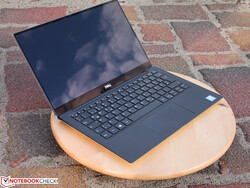
Dell launches the next update of the XPS 13, but the changes are small and do non justify an upgrade from the predecessor XPS 13 9370 (2018), but certainly do justify an upgrade from the 9360 (2016). Its Kaby Lake dual-core CPU is noticeably slower than the current quad-cores.
Dell evidently reworked the temperature control. Compared to the quad-core processor from 2018, the performance is amend, but but under sustained workloads. Many Ultrabooks take to reduce the CPU speed under sustained load to reduce the temperatures; the XPS continues to run at high speeds. The 2019 XPS xiii simply reduces its CPU frequency past eight% on average (compared to the maximum Turbo clock!) and is faster than the Kaby Lake-R quad-cadre in the 2018 XPS thirteen 9370.
The 2019 XPS 13 only reduces its CPU frequency by viii% under sustained workloads and is faster than the Kaby Lake-R quad-cadre in the 2018 XPS 13.
The case design is all the same very attractive with its slim bezels. The changed webcam position (back at the acme) is definitely a welcome modify. Dell now uses 4K panels from AUO instead of Abrupt. We decide similar luminance values, just the contrast is lower and the sRGB coverage is smaller.
The ports remain unchanged: Ii Thunderbolt 3 ports and the USB-C port (with DisplayPort) are good for professional peripherals.
We are happy with the runtime: 8 hours is very similar to the 2018 XPS 13 9370 UHD. We are already eager to run into whether the 1080p SKU of the XPS 13 9380 volition last longer. The 9370 FHD managed 11 hours instead of viii hours (Wi-Fi exam, +29%).
Whatever user disappointed by the low GPU performance of the XPS 13 – only also other popular thirteen-inch Ultrabooks like the Spectre 13, Gram 13 or ZenBook thirteen – should accept a look at the Huawei MateBook 13 i7 and HP Envy thirteen-ah0003ng with the GeForce MX150, which is much more powerful than the integrated UHD Graphics 620 and can also handle games.
This means the XPS 13 is for users without the demand for a powerful GPU and who prefer perfect input devices every bit well equally a big number of ports. The UHD touch version of our test unit suffers from shorter battery runtimes and lower contrast. If you lot want the best mobility possible, nosotros recommend the 1080p SKU. Nosotros will review this version besides in the well-nigh hereafter.
Dell XPS 13 9380 2019 - 2019-02-02 02/02/2019 v6(one-time)
Sebastian Jentsch
Subnotebook - Weighted Average
Pricecompare

Computers always had an important place in my life, starting with an Intel 80286 microprocessor in the early on 1990s. I became interested in the productive side of technology, particularly in campus radio, while studying at TU Chemnitz and during a trainee program in Belfast. Hardware interests led me to manage Notebookjournal.de, which is now a partition of Notebooksbilliger, for a few years. I became self-employed in 2010 and took the side by side logical pace in my career past starting to write for Notebookcheck.
contact me via: Xing

I grew up with modern consumer electronics and my first computer was a Commodore C64, which encouraged my interest in building my own systems. I started working every bit a review editor for Notebookcheck during my dual studies at Siemens. Currently, I am mainly responsible for dealing with business laptops and mobile workstations. Information technology'south a keen experience to be able to review the latest devices and technologies and and then compare them with each other.
.170
Sebastian Jentsch, 2019-01-30 (Update: 2019-02-23)

Dell Xps 13 9380 I5 8265u,
Source: https://www.notebookcheck.net/Dell-XPS-13-9380-2019-i5-8265U-256GB-UHD-Subnotebook-Review.401871.0.html
Posted by: wagnermouldither.blogspot.com
0 Response to "Dell Xps 13 9380 I5 8265u"
Post a Comment